Hello, everyone! And a special hello to my new subscribers! Inside scoop alert! – Be sure to check out the first book in the AlCent Sagas series to get a free Kindle download this weekend. You can check it out on the links below. Look for AlCent Sagas: Book One – Formation.
Today I thought I’d talk about the development of the Central Port Facility which holds a planetary orbit around the star Alpha Centauri B. Lots of action takes place in and around this colossal vessel so let’s take a look at it! (I’m sorry there is no finished cover art work for this vessel from my cover artist Wojtek Kapusta. Though we went no further once we finished the covers, we still plan to create cover art for the CPF and other vessels in the story to be used for posters, stickers, bookmarks, and banners. Stay tuned!) By the way, the name Fu Sang comes from a Chinese myth about a mysterious and beautiful land far to the east. It seemed a fitting name for an interstellar, multigenerational vessel taking people to worlds unknown.
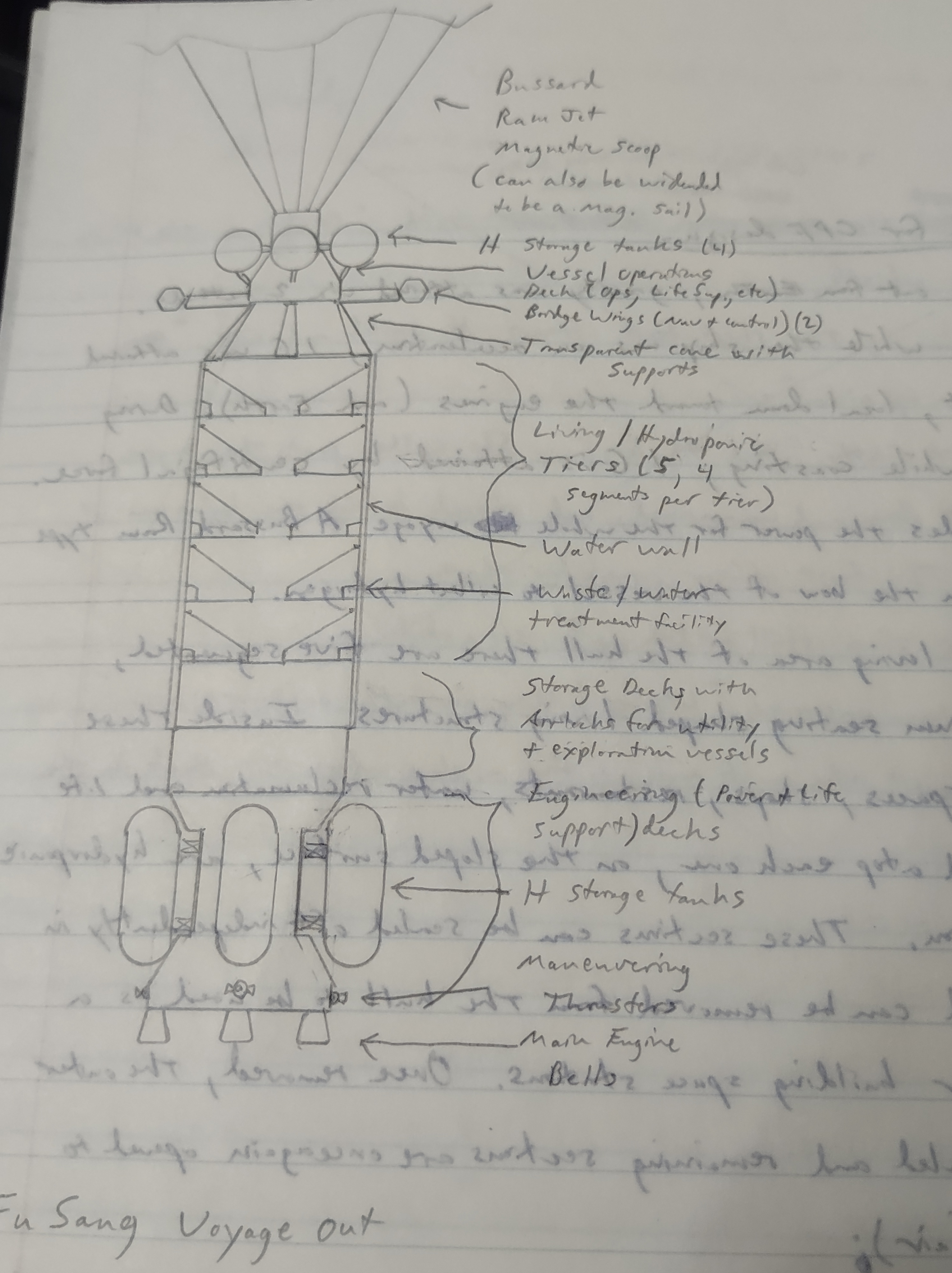
The following paragraphs are taken from my original story notes, and like the drawings above and below, help me to keep all the details of my world building straight in my head. (There are a lot of back story details in a 325,000 word novel series.) All of these details come out at different times through various parts of the story. I find it better to bring out the background that way so as not to bog down the pace of the story. Once you’ve read the story you will understand most of this already. And please ignore any grammatical errors as these are my notes and no editor has ever reviewed them for me.
“As part of an international cooperative effort to colonize the Alpha Centauri system, the Fu Sang was built in orbit around the Earth. (China footed the lion’s share of the cost so they got to name it.) Perhaps the idea was prompted by an asteroid collision with the Earth, or a need to find Earth-like planets to colonize. Since it proved too difficult to colonize or terraform solar system planets (or they had already been colonized), and with the existence of exoplanets discovered on Alpha Centauri, it was decided to send a multi-generational ship there which would bring representatives of participating people groups. The ship would use ion-drive propulsion and a Bussard ramjet-type funnel to collect free hydrogen on the journey. For much of the way the ship would coast using centrifugal rotation for gravity. For the periods of 1G acceleration and deceleration, the bulkheads nearest the engines would be local down. For periods of centrifugal coasting, the bulkheads toward the outer skin of the ship would be local down. The ship and all living and working spaces were designed to accommodate both configurations.
“The living spaces would be constructed in circular, layered segments inside the hull with an open air cylindrical core. The living areas would be divided by populations of participating states and sized accordingly (i.e. – large countries would have larger areas and smaller countries or people groups would have smaller areas) and would be decorated and fitted out suited to the taste and preferences of the people living in them. For instance, China, US, EU, Russia, Brazil, and India would hold larger areas, while the smaller Asian, African, Central and South American, and Pacific Island people groups would occupy smaller areas. The idea was that all people groups of Earth would be represented in the new colonies of Alpha Centauri. Access to the different areas in the Fu Sang would be facilitated by the open air core or by transit tubes running between the various levels and segments. Moving through the various areas of the ship would be a lot like walking through a modern shopping mall where the large nation segments were similar to the anchor stores and the small nation areas were similar to the smaller stores in between. It was hoped that the cultures and languages, and indeed the very diversity of Earth, would be preserved while the lingua franca would be Mandarin Chinese. (Although I studied a little Mandarin Chinese myself, I didn’t really keep to this aspect of my notes in the story. Everyone understands each other and I don’t go into the language issue. One must keep the story moving!) Walking around the Fu Sang would give one the experience of walking around the world.
“Although unstated in official literature, the hope and desire of the colonizers was to leave behind the ancient and inherent ills of the Earth, including greed, indifference, and desire for domination, which inevitably leads to poverty, revolution, and war.
“It was estimated that the voyage would last for 60 years. Families who left Earth would be expected to have children who would carry out the mission, and that generation would have children who would complete the mission. Adults who left the Earth would probably never again see or live on a planet’s surface. The children born en route would grow up never knowing life on a planet until their later years. To minimize homesickness, the elders pledged to speak very little about Earth so that their space-born offspring would accept life on the Fu Sang as a natural form of existence. The elders recorded diaries of their lives on Earth complete with audio and video recordings of landscapes, weather, animals, architecture, music, and arts, and these would be archived until the Fu Sang approached the Alpha Centauri system. Then they would be released and shared abroad to all the inhabitants of the Fu Sang in the hope that the space-born citizens, to whom an existence in space was natural and might see no need to descend to and live on a planet, would be encouraged to explore and settle the new worlds. Men and women on Earth who had been explorers of that world would be held up as heroes.

“Every adult citizen was required to serve in some capacity toward the health of the voyagers on the ship, or to the maintenance and operation of the ship. No exceptions. Children were encouraged to serve in their family’s line of work, but could train for and serve in other areas if they desired. The various occupations included agriculture, water reclamation, sanitation, power generation, equipment and systems repair, and materials recycling. Ancillary occupations such as entertainment, restaurant management, sports, and teaching were either on a recreational/hobby level, or were done on a rotational basis to serve as a vocational holiday. Local government/management and judiciary positions were filled the same way.
“During the last 10 years of the voyage, as the Fu Sang was nearing the Alpha Centauri binary star system, increasing efforts were made to study the various planets of both stars. Earlier efforts were astronomical using telescopes and various instruments, but later were facilitated by space probes and manned vessels which could orbit and land on the planets’ surfaces. It was discovered that Alpha Centauri’s A’s second planet (AlCent A2) would prove to be the most Earthlike and so it was decided to place the Fu Sang in orbit around that planet where exploration and settlement could begin. This became known as Year One.”
That’s enough from my notebook for now. (There is a LOT more.) The drawing above is of the Fu Sang in its original configuration. Keep in mind these rough drawings are mainly for me to fix dimensions and directions in my head, and to help me to remember details. Notice that I am a bit vague about dimensions and mass of the ship, as well as numbers of passengers. This is because I am neither a scientist nor an engineer. Were I to give exact figures, I would open up myself to criticism about the vessel’s feasibility. Most of my readers are very bright people (I know of at least two readers of my books who work for NASA) and they could nitpick the details if they wanted. But since I’m a storyteller, I can gloss over the details and keep the story moving. Were anyone to say to me, “but for that to be true, ________ would have to be _______.” To which I would reply, “Exactly. That’s how they did it!”
Now let’s move onto the conversion of the Fu Sang to its later Central Port Facility configuration. I’ll start by adding more entries from my original notebook.
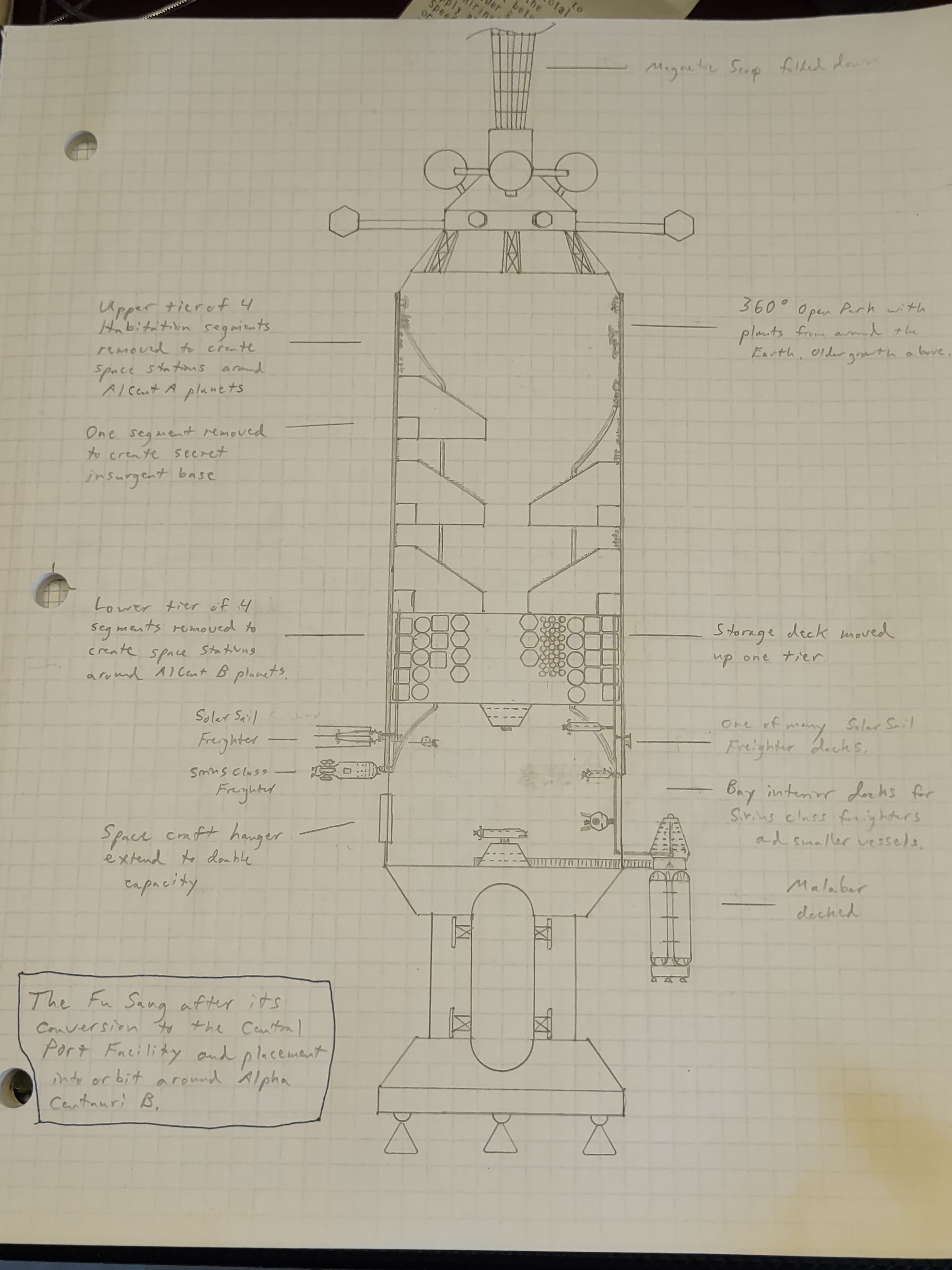
“After 25 years of settlement and growth, it was decided that the exploration of the AlCent B system would begin. The star was on the inbound leg of its orbit so that communication and transportation would become easier over the next 20 years when the 2 stars would make their closest approach at 11.2 astronomical units. (1 AU is the distance from the sun to the Earth. Saturn orbits the sun at a distance of 9.5 AU.) The orbital period between the stars is 80 years with a periastron of 11.2 AU and an apastron of 35.6 AU. (Neptune orbits the sun at a distance of 30 AU.) The Fu Sang was sent to AlCent B and placed in a planetary orbit around the star at a distance of 1 AU. For all intents and purposes, it would function as an artificial planet and once in orbit would be referred to as the AlCent B Central Port Facility, or CPF. It was stipulated by treaty of the Member Nations Council that all exploration of the AlCent B system would be conducted from the CPF in order to preserve the pristine nature of the system. All travel between AlCent A and B would be conducted through the Central Port Facility. All industrial operations would be carried out aboard the CPF. Exploration would be carried out through international cooperation and all proposed settlements must be approved by treaty and be ratified by all member states and people groups.”
I have notes for each of the planets in the system, but suffice to say now that AlCent A2 was divided up like an orange, with slices from pole to pole and wedge shaped to the core of the planet. (The idea was inspired by how King Kamehameha divided the Hawaiian Islands once he’d conquered his foes. We learned that in school there.) These segments were allotted to the various nations and people groups, and then subdivided between family groups. Not doing this in the AlCent B system becomes one of the causes of contention for the citizens who started new lives in the AlCent B system.
Notice how some of the segments have been removed between the first and second drawings. Each segment can be sealed off from the others, not only for safety during the interstellar voyage, but also so they can be removed to provide foundations for space stations around each of the planets. The upper tier was removed to provide space stations for the planets of the AlCent A system. (I admit, they would look like strange “stadium seating segments” and unorthodox as space stations, but they would be wonderfully functional!) The resulting void in the hull was turned into a park that ran around the entire inner surface of the ship. Later this would be called the “360 Park.” The lower tier of segments was removed to provide space stations for the planets of the AlCent B system. Once they were gone, the storage area was moved up one level which allowed the hangar bay to be extended, doubling its size.
The sloping nature of the hydroponic gardens allowed for plant growth in both the 1G acceleration/deceleration periods, as well as during the centrifugal coasting phase. Agriculture is still carried on in the time of our story using a varysium-based gravity. (More on that later.) Solar lamps located at the bottom of each segment provide sunlight for the plants of the garden segment below.

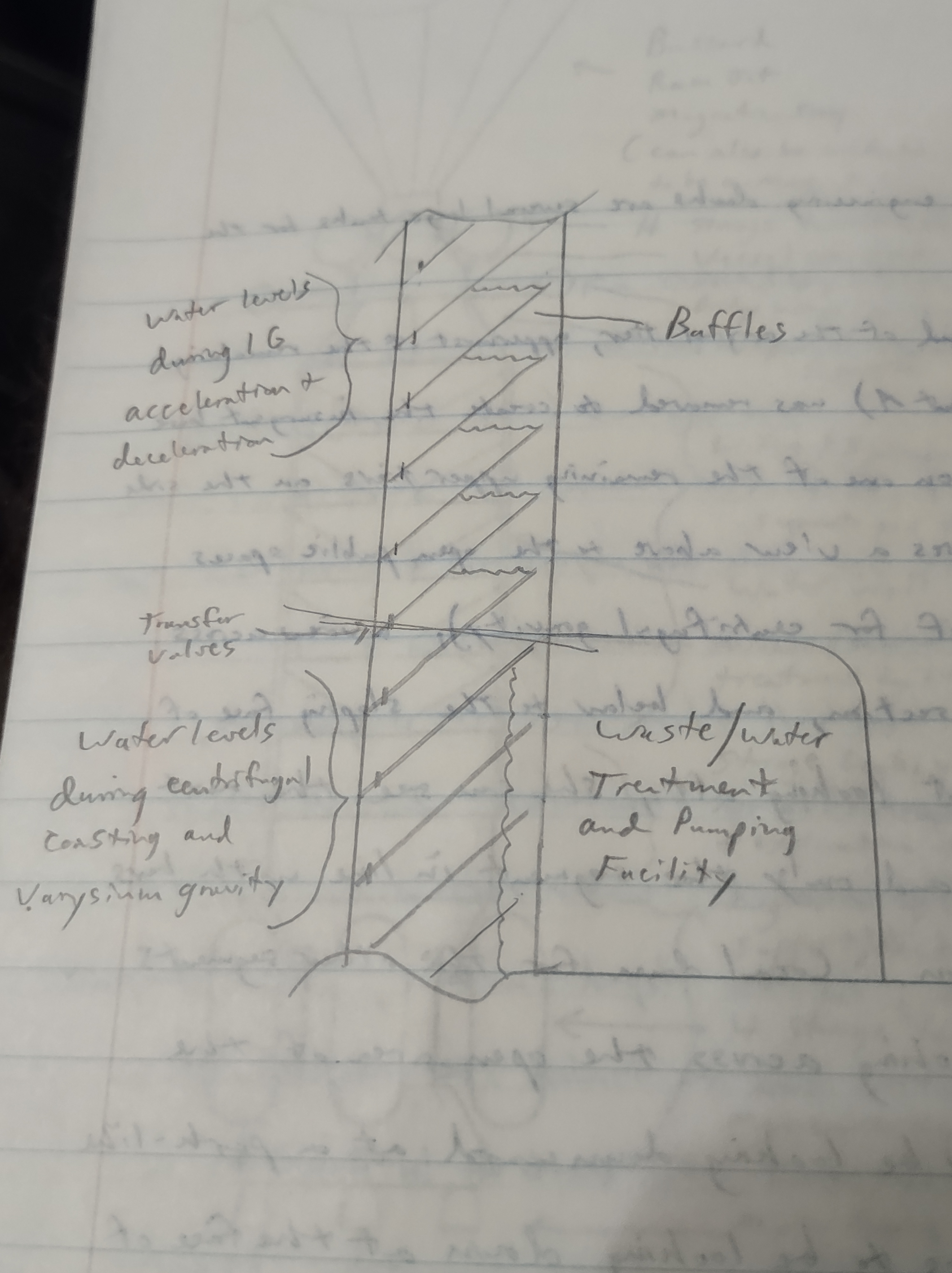
To protect the voyagers of the Fu Sang, and later the citizens of the CPF, from cosmic radiation, the entire outer hull has been configured to contain all of the vessel’s water supply. Baffles within a two-layer “water wall” system allow for even distribution of the water whether the ship is in its acceleration/deceleration phase or its centrifugal coasting phase. A waste and water treatment plant is at located at the lower, outer center of each segment. The hydroponic gardens help to clean the water, as well as provide a natural source of oxygen and food for the inhabitants. The entire outer hull of the CPF was fitted with solar panels to augment the power supply of the fusion reactor plant.
Well, I guess that’s about all I can cover about the Fu Sang/Central Port Facility (2200 words worth). As I said before, much of the stories in the AlCent Sagas series take place on the CPF. It’s even mentioned in Seed of Aldebaran! If you read through this post, and have read the series, please let me know if you saw the setting in the story as I had intended to portray it in the notes. That would be valuable to me as a writer. Also, if you like this kind of post, let me know and I’ll type up more of my old notes. (Man, there are a lot of them!) I will also share any new art we create along these lines. Until next time, happy reading!
Novels by James Crawford (available in print, eBook, and audio book) –
Mariner Valley – https://www.amazon.com/dp/B0141N9UXO
Seed of Aldebaran – https://www.amazon.com/dp/B08SHXTRMP
AlCent Sagas Book One: Formation – https://www.amazon.com/dp/B0CQ5C3TQT
AlCent Sagas Book Two: Revelation – https://www.amazon.com/dp/B0D2FRH6Q8
AlCent Sagas Book Three: Investigation – https://www.amazon.com/dp/B0D5SBFYMW
AlCent Sagas Book Four: Desperation – https://www.amazon.com/dp/B0D8767LHL
AlCent Sagas Book Five: Confrontation – https://www.amazon.com/dp/B0D9PPTX6G
A Noble Paradise – https://www.amazon.com/dp/B00QG6LZ10
Cover artist Wojtek Kapusta – https://www.artstation.com/kapucha76
Audible narrator Lyle Blaker – https://www.acx.com/narrator?p=AXZPXFQRN07M3
Discover more from james crawford
Subscribe to get the latest posts sent to your email.
 james crawford